Showing posts with label brain. Show all posts

Monday, August 20, 2012

ApeWorm Brain Overview

(part of the series Aping As the Basis of Intelligence)


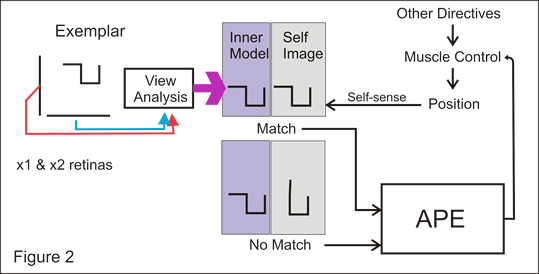
Figure 2 gives an overview of the ApeWorm "central nervous system" or control system. 

Two eyes or retinas gather information about the exemplar that is analyzed to form an exemplar inner model. The ApeWorm also analyzes it internal sensors to construct a self inner model, or self image. If they match, the Ape control function registers success and indicates to the muscle control functions to stop movement. It also may reinforce the "synapses" or weights that led to the success, including any temporal sequence involved. If there is No Match, muscle control allows movement to continue.

It should be noted that the compartmentalization of functions in Figure 2 need not necessarily correspond to how the system is constructed. A neural model might make it possible, or even necessary, to tightly integrate two or more, or even all, of the functions that seem separate in this analysis.

Tuesday, June 5, 2012

Aping as the Basis of Intelligence

Logic was thought to be the key paradigm for human intelligence from the Aristotle to Wittgenstein, and then in the early days of Artificial Intelligence as implemented on computers.

Careful consideration shows that aping, the ability to copy an action of another individual, is more central to intelligence. It is as much a mammal trait as a human one. Formal exercises in logic are not needed for one animal to learn behavior from another. The complex neural circuitry created by evolutionary pressures to enhance aping potential eventually became the basis of human language and its formalized reasoning skills known as logic.

Aping consists of observing (usually visually) what some other individual is doing, and then copying that behavior. Humans do this so naturally that we seldom think about it consciously.  Unless trained to do so (by aping others), practicing logic is a much harder skill. Yet logic circuits are easy to implement with electronic parts. Aping another individual requires very complex systems within the brain.

This essay, and the accompanying computer programs and physical systems, is an attempt to create machines capable of aping, which then should be able to handle other complex behaviors usually associated with human intelligence, including language, mechanical skills, reasoning, and possibly consciousness.

The advantage of aping skills goes beyond helping to ensure the survival of an individual animal. With aping a behavior with survival benefits can become cultural, spanning an unlimited number of generations of animals. This without any genetic change specific to the behavior itself. A generalized pool of neurons can become capable of generating a wide and flexible variety of behaviors, giving a species a heavy advantage over animals that can only engage in behavior based on  pre-programmed neural systems.

Pre-language example. Consider a simple aping process and how it differs from paradigms like ordinary remembered (learned) behavior. An animal, a young wolf,  has always simply crossed a cold stream by simply plunging through it. One day it sees an older wolf stop at the stream and proceed along the bank to a point where there is a rock in the center of the stream. The older wolf jumps to the rock, then to the far bank, thereby avoiding getting wet while crossing. The young wolf then apes that behavior. Afterwards, when crossing the stream in that area (when not in hot pursuit of prey) the young wolf  diverts to the special crossing point.

Note how the aping behavior differs from what might be other reasons for using the rock to cross. The young wolf could learn of the rock crossing by exploration, then would remember the location of the crossing when appropriate. You could argue that following an older animal might be an instinct, so this is not a real example of aping, just a side effect of following.

Aping behavior might have originated in following behavior, and the basic ability to learn from experience, but as more complex situations are involved, it becomes clear that aping is a special case requiring special capabilities.

Supposing this simple example constitutes a form of aping, what can we say about how it is accomplished by the wolf brain? The wolf is capable of recognizing an externalized self. The example wolf, to the aping wolf, represents a possibility for itself. Metaphorically, the aping wolf can see itself crossing the stream using the rock when it sees the example wolf. So the wolf-brain is capable of contemplating (in a very simple, non-philosophic way) the future. It can choose to ape the example, or it can refuse to cross the stream, or it can ignore the example and get wet and cold crossing the stream.

Aping, in the infants of actual apes including humans, is probably automatic. Only at a later time will the young apes start choosing whether or not to ape particular behaviors. There is typically outside support for aping in human children. We reward them when we like their aping efforts, but may discourage them when we don't like their efforts (as when they engage in behaviors culturally reserved for adults).

Consider the "simple" modern act of making a piece of toast with a bread toasting appliance. A child is not likely to learn to do this by accidentally taking a slice of bread, sticking it into the appliance, and pushing down the lever. A child learns this by watching a example or exemplar. The child understands that doing what an exemplar does leads to the same result. The child sees that taking a piece of bread, placing it in a certain way in the appliance, and pressing the lever results in the making of toast. Usually, if sufficiently coordinated, a child can do this on the first try. Aping often results in some level of success in achieving a goal on the first try.

To ape an exemplar the aping child must already have similar levels of muscle control and sense of where its body is in relation to its surroundings. It must understand that aping the exemplar's movements (or other behaviors like vocalizing) achieves a desired result. If an aping attempt is made that does not achieve the desired results, a child may conclude that something is missing from the aping process, a subtlety or trick.
To ape, the brain must have a number of capabilities, which might be summed up as the ability to coordinate the body of the subject with the body of the exemplar.

In humans, when children are quick to ape adults, we call them intelligent. If they are slow to imitate adult behaviors, we call the slow or less intelligent.

Language learning example. Human babies start learning to imitate vocalizations soon after birth. Vocal fussing often results in rewards, like feeding, encouraging further vocalizations. The process may seem like a long one when mechanical devices have long existed that can record and play back sounds and language. There is a fundamental difference between the mechanical play back model and the aping vocalization model that is critical to the reconstruction of how humans are capable of intelligent behavior, including understanding how the world works. [I prefer Machine Understanding as a term for what we are working towards with computerized robots capable of aping, because Artificial Intelligence has largely ignored a set of crucial problems that logic circuits have difficulty handling].

The human brain does not appear to be a recording medium in the sense that a phonograph, magnetic tape machine, or silicon-memory based sound recording and playing device is. The human ability to immediately repeat a phrase of language or hum a melody does not arise from a like mechanism. Humans have fairly good memories, but a weak ability to memorize.

Consider the problem, for the human brain, of learning to repeat its first few spoken words, say "mama, papa, no, puppy, bye, milk." In the ear there are a number of sensory cells that respond to different frequencies of sound. They send nerve impulses towards the brain. At the other end we have the sound making machinery: lungs, vocal cords, and mouth. An infant screaming soon after birth indicates that machinery works, but is nothing like language. Months of hearing and experimental vocalizations follow. There may be feedback, positive or negative, by parents and other exemplars, as well as careful repetition of simple words in the hope this will induce aping by the child.

In the end, however, success is the ability of the child to say a word that sounds, to its own ear, like the kind of words spoken by the exemplars. It will not be identical, nor will it ever be identical, in its fine structure, in fact it will be identifiably different, an individual voice. Six words mastered, many more will follow, all aped after exemplars. In addition, the words will have meaning: they will coordinate with objects or actions in the external world (or internal world, as with "more" or "hurts").

The neural machine that coordinates heard words and the speaking of words with an "ego" must be very complex and very capable. Recreate that machine and we would have a model that, perhaps with some specialized variations, would be able to ape visual input to body positions, or anything else required of it.
Wednesday, November 16, 2011

stuck

Maybe we need the equivalent of a quantum hypothesis for the brain, in the sense that it may not be possible to construct a corrrect model based on classic principles, no matter how complex.

Thursday, September 22, 2011

Brain Modeling Computational Trajectory

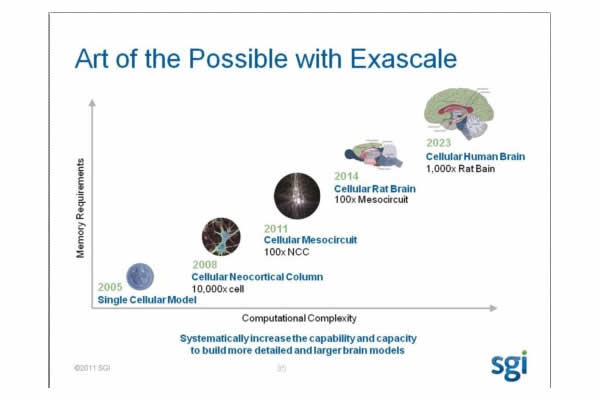
SGI is a manufacturer of high-performance computers, what might be called small supercomputers. I was listening to their analyst day (I own stock in SGI) this morning and saw an interesting slide, which I reproduce here:
brain modeling projection

With regard to machine understanding, this is the direct assault method. At some point when the human brain is modeled in sufficient detail the construct should display human memory, intelligence, and even consciousness or self-awareness. It is conceivable that a detailed computer model might exhibit artificial intelligence or understanding but leave us still unable to comprehend the essence of what is happening. More likely we will be enlightened and therefore able to construct working machine entities that have true intelligence and understanding, but are not exactly modeled on the human nervous system.

There are different levels for modeling biological systems of neurons and brain matter. We might model on the atomic, molecular, sub-cellular, cellular, or neural-functional level. It is not clear what level of detail is assumed in the SGI projection. Best guess is that is has a model for individual neurons, but the complexity is added by adding additional neurons to the network. That would be the main difference between modeling a "cellular neocortical column," a mesocircuit, a rat brain, and a human brain.

SGI already makes computers for researchers in this field. Of course other vendors' computers can be used. The advantage SGI brings to the table today is the ability to build a large model in computer memory chips (the processors see a big, unified memory), as opposed to hard disks.

I would be very impressed if someone could correctly model a functioning rat brain by 2014. Keep in mind that just because the computer power is available to do it, does not mean that any given team's model is correct. I wonder what proof on concept would consist of? To test such a brain you would need a test environment. That might be a simulation, but it could also be robotic. Keep in mind that much of what a rat brain does relates not to what we think of as awareness of the environment, but to maintaining body functions.

Another issue is the initial state problem. Suppose that you "dissect" a rat so that you know the relative placement of every neuron in its central nervous system. Still, to make your model work, you would need a functional initial state for all the the cells. You need to know how synapses are weighted. Probably someone is working on the boot-up of mammal brains during embryonic development. Even just getting the genetically re-programmed neurotransmitter types for each synapse to each cell seems like a more difficult problem that making a generalized computer model based on a neural map plus a generalized neuron.

Apparently there is plenty of work on this project for everyone.

Wednesday, January 12, 2011

Eyes Follow Brain Shifting of Attention

In case you missed it:

Human Brain Predicts Visual Attention Before Eyes Even Move

This is a confirmation that one of the principle jobs of the brain is to make predictions, then use the senses to confirm or deny the predictions.

Thursday, March 18, 2010

Evaluating HTMs: CPT details; specific memories

This is the last essay on "Hierarchical Temporary Memory, Concepts, Theory, and Terminology" by Hawkins and George. Here I review two issues raised in Section 6, Questions: details on how conditional probability tables (CPTs) work with HTMs, and why humans can have specific memories of events, but HTMs as currently described do not. The first is very technical, the second has more interesting implications.

CPTs are used in Bayesian networks to allow the belief (a set of probabilities about causes) of one node to modify another node. They can be create from algorithms using probability theory in conjunction with known data, the beliefs already established in the two nodes. In HTMs they are learned. As the quantization points are learned, the CPTs are the same as the learned quantization function that links the points to the temporal variables. There are two separate algorithms, but they run in parallel, creating an output to send up the hierarchy to the next node. This will probably because more transparent when we look at the actual algorithms used by the HTM nodes.

It is claimed that humans can remember specific details and events, as well as model the world, whereas HTMs don't keep specific memories. The authors talk about how the human brain might accomplish this feat, and how the capability might be added to HTMs. I instead wonder whether they are right about humans remembering specific details of specific events.

It certainly is the naive view, and since I subscribe to the common sense school of philosophy (with my own updates), assailing the view is mainly just an exercise at this point. But consider this: numerous studies have shown that eye witnesses are unreliable. I suspect that a visual memory is not like a photograph, nor is the memory of a song like a recording, nor is the memory of an event a sort of whole sensory record of a period of time. I believe humans do remember things, and can train their memories to be more like recorders, and in particular can memorize speeches, poems, sequences of numbers, etc. But I think the HTM model actually is at least approximately the way that the brain works. Different levels of the neurological system remember, or become capable of recognizing, different levels of details about things. There are mechanisms in the brain that allow recall of these memories on different levels. But I would be careful about assuming that because we can recall an event (or picture, etc.) in more or less detail we must be calling up a recording. We seldom learn anything of any length in detail by simply hearing or seeing it. If you have memorized that the first digits of pi are 3.14159, what is that a recording of? The words for the number sequence as sounded out in English, a visual memory of seeing this number in a particular typeface in a particular paragraph on paper of a particular tone, or an abstract memory corresponding to abstract groups of abstract units? Typically we must be exposed to something many times to be able to remember it or recognize it, just like an HTM.

I think we are so good at reconstructing certain types of memories that we think we have photograph or video-like recordings of them. That is why eye witnesses think they are telling the truth, when they often substitute details from other events into a "memory" [notably, a face from a lineup that actually was not present at a crime scene]. That is why our memories are so often mistaken (I could have sworn I turned off that burner!) and why we can recall so much without having a roomful of DVDs in our brains. Our memories are largely indistinguishable from our intelligence, and are both fragmented in detail and yet easily molded into a whole as necessary. This is why recognition is usually much better than recall.

The more I study HTMs, the more curious I get. I don't know what the next step will be in my investigations, but hopefully I'll let you know soon.

Saturday, November 14, 2009

Review of Towards a Mathematical Theory of Cortical Micro-circuits

This is a report on my first reading of "Towards a Mathematical Theory of Cortical Micro-circuits" [Dileep George & Jeff Hawkins, PLoS Computational Biology, October 2009, Volume 5, Issue 10]. There were some bits of it that I had to treat as black boxes, but on the whole I found it comprehensible.

The core concern of the paper is to map a particular attempt to use computers to implement the Memory-Prediction framework of human intelligence to what is known about how nerve cells actually function in the cortex of the human brain. The specific machine methodology is called Hierarchical Temporal Memory (HTM). The article begins by explaining how HTM operates, then proceeds to map HTM processes to the cortex.

HTM structures are called nodes, but it should be noted that the nodes have extensive internal structure. They can have multiple inputs and outputs. They can have multiple "coincidence pattern matrices" and Markov chain processes. There are four major equations sets necessary for calibrating the nodes. I suggest you take a look at the HTM Technology Overview if you have not already. In particular, the authors assume the readers understand how Markov chains work, which is not obvious in this context.

It should be noted that HTM nodes are typically found in a hierarchy of nodes, and that information can move both up and down the hierarchy. The bottom of the hierarchy would typically correspond to sensory input, the top of the hierarchy to conceptual modes.

In fact, I found it easier to understand how the HTM worked internally when the authors started explaining the details in terms of neuron processes. The Markov chain likelihood circuit (Figure 4), in addition to mapping neurons to an aspect of an HTM node, makes it clearer that a Markov chain, in this context, is a set of information that has (or could have) predictive value. Markov chains are learned expectations about probabilities that events will occur in a time sequence.

This is a good example of a premise of the Memory-Prediction framework. The Markov chains are a sort of memory, yet they also are used to process information to make predictions. In computer science we tend to separate out memory from logical operations, but in the brain they are mostly inseparable.

As to the nervous system side of the mirror, I was not surprised to see a lot of the more complex work being performed by pyramidal cells. This neuron type appears to be quite differentiated from the more ordinary neurons that mainly relay information between muscles or sensory cells and the brain. Their very size and location in the cortex (particularly in layers 2, 3, and 5) should arose anyone's curiosity. Whether they really play the roles assigned to them here is not generally known, but hypotheses are made that should be testable.

The paper also covers the use of HTMs to recognize visual objects. Since much of the work done by Numenta and others using HTMs is in this field, I won't comment further here except to say that I found the work on the subjective contour effect particularly intriguing (example of subjective contours: Kanizsa triangle).

Merely categorizing visual objects is a more difficult problem that was originally thought by computer scientists working on Artificial Intelligence (AI). It is not learning about the successes with HTMs with pattern recognition that excites me. It is the way that it is done, and the promise that implies. I want to understand how the brain works in detail, but the ultimate goal is to understand intelligence, awareness, and understanding itself. The way HTMs process information, including the flowing of information both up and down the hierarchy, seems like a necessary condition for attacking these problems of higher intelligence. I don't think anyone thinks HTMs will prove to be entirely sufficient, but they seem like a good starting place for further physical and philosophical investigations.

Wednesday, October 14, 2009

Markov Chains for Brain Models

I got an email from Numenta today, telling me that Dileep George and Jeff Hawkins had a paper, "Towards a Mathematical Theory of Cortical Micro-circuits", published in the PLoS Computational Biology journal. Part of the abstract states:
“we describe how Bayesian belief propagation in a spatio-temporal hierarchical model, called
Hierarchical Temporal Memory (HTM), can lead to a mathematical model for cortical circuits. An HTM node is abstracted using a coincidence detector and a mixture of Markov chains.”

HTM is the model being used by Numenta and others to crack to machine understanding problem by making an abstract, computable model of the human cortex (brain). I figured the article would explain “Bayesian belief propagation” which parses into three words I understand. I knew I had run into the term “Markov chains” before, in probability theory and elsewhere. I thought I would just refresh my memory about good old Andrey Markov with Wikipedia. But the Markov chains article at Wikipedia was tough going, jumping into the math without clearly explaining it in English. The definition there was comprehensible: “a random process where all information about the future is contained in the present state.” That implies there is a set of rules, expressed as probabilities, so that if you know the current state of a system you can predict its future state probabilities. It neatly combines determinism with indeterminism. For a first impression, I found the Examples of Markov Chains article more helpful.

I thought I might find a better explanation on my book shelf. There was nothing in my Schaum’s Statistics, but my next guess (thank you, cortex) Schaum's Outline of Operations Research
by Richard Bronson and Govindasami Naadimuthu, has an entire chapter, “Finite Markov Chains,” starting on page 369.

Markov chains are a subset of Markov processes. Markov processes consist of a set of objects with a set of states for the objects. At each point in time each object must be in one of the states. As time progresses, “the probability that an object moves from one state to another state in one time period depends only on the two states,” the current state and the probabilities for the future states given the current state.

For example, in the board game Monopoly each “square” or piece of real estate is part of the set of objects. The two dice create a probability structure, the standard one for two dice. The probability that, at any point, a player will transition to the same point, the forward adjacent point, or any point beyond the 12th point forward is zero, because the dice can only roll numbers between 2 and 12. However, more typically there would be a set of states and a probability for the transition to each of the states, including the transition of remaining in the current state.

If there are N possible states, and you know all the probabilities for transitions, you can show this and manipulate it mathematically with a matrix P, the stochastic or transition matrix. There would be N rows and columns in P. As in all probability theory, in any row the probabilities add up to 1.

N=2 is the simplest meaningful number of states. Let’s call them black and white. It is really only interesting if the transitions are different. Say 90% of the time black transitions to white, but only 20% of the time white transitions to black. Then the matrix P would be

.1 .9
.8 .2

There is some ability to predict the future in a statistical way if you have a Markov chain like this. Without doing any math, you would expect over time that if you have only one object, it would probably be white. If it is black, probably the next state of the sequence flips to white, but if it is white, probably the next state will be white. If you have a large number of objects, you can know the likelihood that a given percentage of them will be white or black. Yet you can’t know for sure. Even the least likely state, all objects black, can occur at any time if each black stays black but each white transitions to black.

You can see that Markov chains might be used to represent the states of neurons or of collections of neurons. In my simple examples above, each object influences only its own future state. But in real systems often future state probabilities are determined by the states of a collection of objects. It could be a collection of transistors, or a collection of nerve cells, or HTM nodes.

Saturday, October 3, 2009

The Amazing Genetics of Nerves

I'll start with a quote from Stephen W. Kuffler, John G. Nicholls and A. Robert Martin's From Neuron to Brain (second edition, page 177; 1984 Sinauer Associates Inc.):

"... conduction velocity plays a significant role in the scheme of organization of the nervous system. It varies by a factor of more than 100 in nerve fibers that transmit different information content. In general, nerves that conduct most rapidly (more than 100 m/sec) are involved in mediating rapid reflexes, such as those used for regulating posture. Slower conduction velocities are associated with less urgent tasks such as regulating the distribution of blood flow to various parts of the body, controlling the secrection of glands, or regulating the tone of visceral organs."

Presumably much of this fine-tuning was achieved in mammals long before humans evolved. It is a great example of what can be achieved with evolution through natural selection. Apparently there is a cost to speedy nerve connections. There must be genes that can be turned on to produce extra structural elements (proteins, fats, etc) that speed up transmission velocity. There must be controlling genes that turn the structural genes on and off during nerve development, as appropriate.

Given these possibilities, there must be an overall genetic blueprint for nerve transmission velocity types. This blueprint would have been fine-tuned over time through the survival of the fittest. Having high cost, fast transmission where needed, and low-cost slower transmission where that will do, would give a slight evolutionary advantage.

The issue of transmission speed would be relatively simple comparted to creating a genetic blueprint for the orders-of-magnitude more complex human brain. Yet the construction process would be similar. A variety of brain cell types were already developed by mammals and primates. Probably (please comment if you know!) more cell types, including synapse types, evolved (from the usual mutation + selection process) for the human brain. The overall structure of the brain could be one blueprint, but it is an extremely complicated one. We know it involves axons and dendrites often both connecting to neighboring neurons and running long distances to connect to neurons after bypassing thousands, millions, or billions of closer neighbors.

This could only happen through evolution. Again, we have Charles Darwin to thank for setting us on the right path to understanding both nature and ourselves. As to machine understanding, the human brain is our best blueprint.

Wednesday, July 8, 2009

Numenta

While I am getting up to speed (a slow process, given my other commitments), there is no reason for someone who is interested in this topic to zoom to the cutting edge. A good place for a jump start, after you have read On Intelligence, is the Numenta web site. You can also check out the OnIntelligence.org web site, which sponsors some forums on Hawkins's predictive memory model of intelligence and has some links to related materials. Today I'll just describe what is at the Numenta site.

If you have not read On Intelligence, in particular Chapter 6, "How the Cortex Works," you can still get a lot out of reading materials at the Numenta site. However, I would advise reading the book first, old fashioned as that may sound.

You might be ready to jump right into "Hierarchical Temporal Memory Concepts, Theory and Terminology" by Jeff Hawkins and Dileep George. You are going to want to read it at some point. It is focused on HTMs (Hierarchical Temporal Memory technology). This is an attempt to implement the model of the human brain cortex, but in data-processing rather than biological terms. It is also the main technology being developed at Numenta.

On the other hand you may want to look at the HTM Technology Overview first. It is short and sweet, and also has a link to Problems That Fit HTMs. Of course if the HTM actually is a good model for the human cortex, HTMs should do well at problems that people (and often other mammals) do well at, but that computers, even using AI (artificial intelligence) techniques are not good at.

If you are a hands-on person, you could skip the theory and start with one of the software development kits. One is Vision Software, the other is NuPIC which now includes Vision. However, the NuPIC web page has a link to technical resources that would be important if you get serious about working with HTMs.

I'll write more about Numenta, just as I'll be writing more commentary on machine understanding and intelligence in general. I will be approaching HTMs from a critical perspective: do they implement a predictive memory model; is this the best implementation; and is the model really central to biological intelligence and machine understanding.

Wednesday, April 8, 2009

The Cortex, Dogs, and Changes of Coordinates

I finished my second read-though of On Intelligence by Jeff Hawkins several weeks ago. I got a lot out of this reading, and even was able to follow the details of Chapter 6 which eluded me the first time. Despite good intentions I neglected to write down my much-provoked thoughts until now. I have been spending most of that time indexing the new edition of Windows Internals by Mark Russinovich et. al., which is interesting in an entirely different way: one sees the products of human intelligence, but it is obvious that there is no danger of a Windows operating system of the current style becoming intelligent or conscious, ever.

In addition to following Jeff's suggestions about noticing how my own mind works, I have been thinking about these matters while watching my dog, Hugo. Let's say he represents mammals in general. He may not have the big old cortex that Jeff admires so much, but he seems to be constantly using his little one to make predictions. Hugo has to make a lot of decisions, and he often freezes in place while making them. Come when called? Maybe, maybe not. A treat in hand might just mean being captured and taken indoors, or left out of a car ride. To make such decisions, I believe, Hugo has to predict outcomes.

Like most dogs, Hugo likes to chase thrown toys. He has come to associate arm movements with probable outcomes. He knows if you are throwing in a particular direction, and begins his run in that direction without waiting for the toy to be released. He expects the toy to appear in front of him. If it does not, he looks back. Will I go ahead and throw the toy past him, or throw it in another direction.

Do this a few times, and he stops dashing as soon as my arm is moving. He waits to see if and where where I actually throw the toy.

I also believe Hugo has a construct of the world very similar to our human construct. He navigates the real world with an ease that can only come from having an internal map of the world. He understands the three-dimensional nature of the world, and in particular that obstacles like a tree or a house can have space behind them.

All this means is that if we want to build cortex like machine designs, we can do a lot without having to recreate a human brain. A car as smart as Hugo could go anywhere it wants on roads without smashing into other cars. This reminds me of science fiction stories where human brains are disembodied and plugged directly into space ships.

So maybe our first goal should be to create animal-brain equivalents and see what can be done with them.

I just happen to be reviewing the branch of mathematics that deals with changes of coordinates. I've always wanted to understand quantum physics and general relativity better, so I occasionally break open a math book, because at some point you must do the math to know what the smart guys are talking about. It is clear to me that human brains, and probably mammal brains too, are pretty good at changes of coordinates. The fact that we construct a mental map of the world and so easily map visual, audio, and tactile coordinates to it and back again is pretty remarkable.

I am again about to review how invariants are treated in tensor mathematics. Maybe that has nothing to do with the ability of the cortex to navigate the world, but it just might. Our brains certainly are good at creating invariant memories and comparing them to real world experiences.

Using the cortex to analyze the cortex: now that is a wonder.

Wednesday, January 21, 2009

Gambling, Addiction and Prediction

Why do people love to gamble? True, there is a range of how much various people like to gamble. At one end there are people are (or pretend to be) bored by it (I exclude people who, for whatever reason, won’t even try games of chance or skill). At the other end are people who lose their savings, homes, and families, or even fingers and lives to legal and illegal gambling operations.

It may all have to do with the brain’s built-in prediction mechanisms.

According to Jeff Hawkins’s theory of the sequential and predictive basis of human intelligence, the primary intelligent function of the brain is to remember sequences of data and use that memory to predict future sequences of data. This is true both for sensory data that we think of as naturally sequential, like the notes in a music tune, and for sensory data that we normally think of as non-sequential, like the features in a human face. According to the theory we construct a model of a human face from sequences of visual input (supplemented by other data, like touching one’s own face). If we see an eye, we expect to see a sequence of other features: another eye, a nose, mouth, eyebrows, hair, chin, ears. We expect to hear a voice when a mouth moves, but not when an eye blinks.

An important element in building a model of the world is surprise. Using memory, the brain predicts what it expects to see, hear, and feel next. When something different occurs, the element of surprise turns on higher functions in the brain. We may look at something more closely. Perhaps it is a face, but it is a strange face. Is this a sign of danger? Friend or foe, we need to memorize the new face and whatever we associate with it (perhaps the face belongs to someone who is being introduced by a friend; we need to remember that association, or the physical place where we met the person).

There is a bit of a nervous rush when a prediction is made that turns out to be false. The mind gears up to determine why it made a false prediction, both in order to deal with the unexpected situation and to be able to predict it in the future. Probably this rush is partly neurochemical. We’ll call it a bit of adrenaline, although it is possibly based on another neurotransmitter or hormone. Adrenaline rush is the lay term I will use.

Games can teach, and they can while the time away. Even when they are not played for money or prizes, they can have an addictive quality. In almost every game an element of prediction is involved. The outcome provides relief if it was predicted, and a rush of neural activity if it was not predicted.

Generally, people like adrenaline rushes, especially in small doses. They like a thrill more than they like boredom. Games are played partly because they provide small, safe levels of thrill in situations that would otherwise being predictable and boring.

Gambling involves making a prediction. It involves two highs for the human brain. Most of us enjoy winning. Getting money from winning gives the same motivation as getting a snack, affection, or a pay check.

I believe that it is losing, however, that makes gambling addictive. When you lose in a random game of chance, your brain is fooled. It made a prediction. It was surprised by the outcome. Now it is designed to frantically memorize what happened and construct a way of making a correct prediction.

Gamblers often come to believe, after a string of losses, that they are about to make a correct prediction or a series of correct predictions. This is how your brain works: long experience has taught it that nature is a set of sequences, and past sequences can predict future sequences. The brain is fooled by the artificial construction of random events like dice throws, roulette wheel spins, and card deals. Worse, there is a sometimes-confusing element of predictability to some of this (two dice will roll a seven more often than a two; in poker three of a kind comes up more often than four of a kind) that tends to reinforce the brains belief that it can make sense out of randomness. The brain persists in the false belief that random events become predictable if only you keep placing bets long enough.

There is a rush when losing. People, on a chemical level, don’t feel pain when they lose. The chips or money they gamble is abstract, removed from the necessities or pleasures they could buy if had not lost. But the loss forces the higher intelligence centers of the brain to gear up. It is like taking a tiny bit of a stimulant. It is pleasurable.

This is often why otherwise highly intelligent individuals will lose vast sums of money in casinos. It is precisely like drug addiction. They may, at some conscious level, when away from a casino, coldly say that they understand they cannot beat a random game with odds set so that the house wins. But in the casino they cannot get out of the loop of feeding themselves tiny bits of adrenaline with each wager, win or lose.